What you will find in this guide
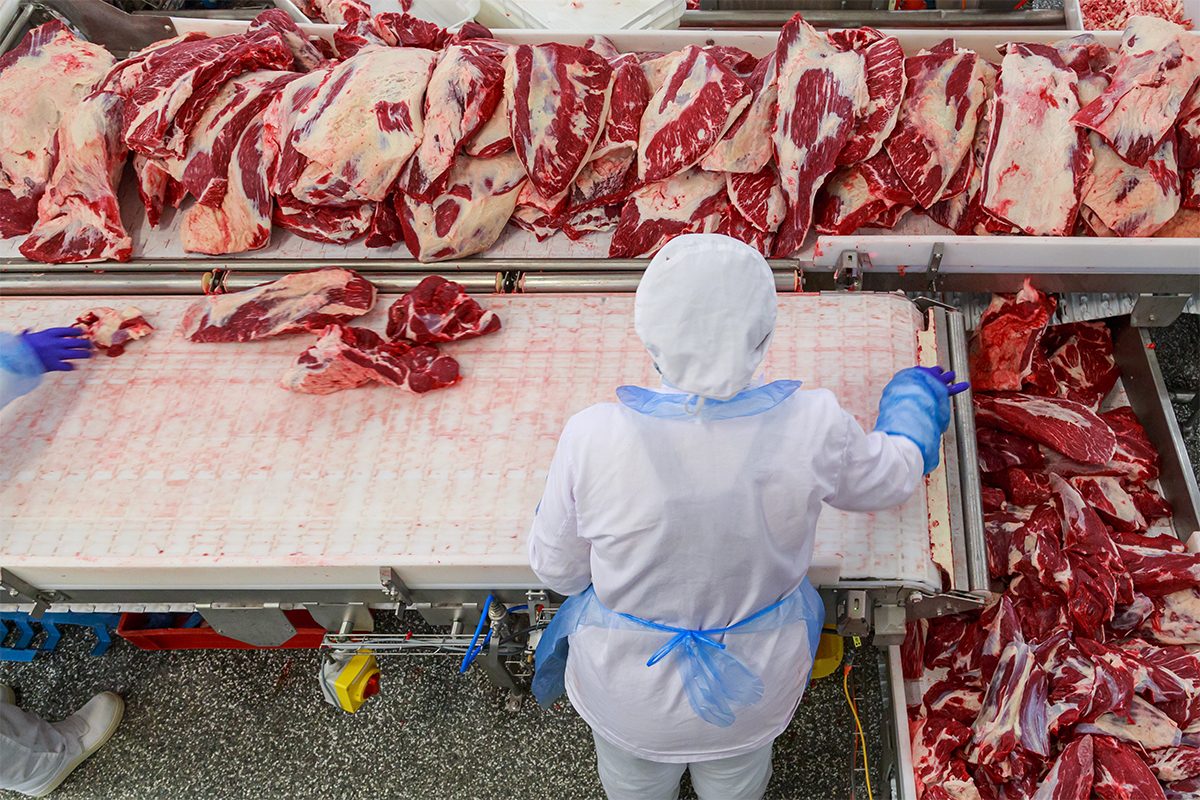
- Trim: Standard procedures and precision cutting to customer specifications for enhanced meat processing yield
- Check: Quality checkpoints and controls that eliminate rework and giveaway
- Recapture: By-product recovery and directing products to the highest-value customer
- Automate: How advanced vision systems integrate all three steps to multiply gains
Trim: Standard procedures and cutting to customer specifications
Achieving a 1.5% meat processing yield gain frequently begins with the basics. Precision trimming is the stage where most processors either quietly forfeit value through excessive trim and rework or capture it through consistent, standardized methods.
Establish trim plans aligned to customer specifications
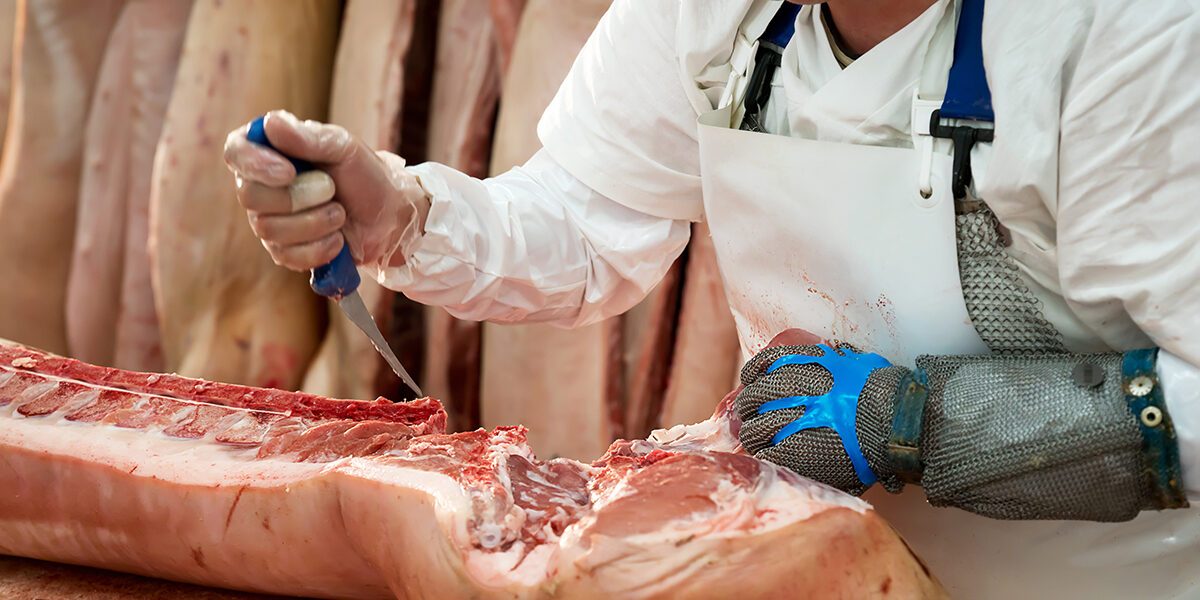
Develop a visual trim plan for each SKU and customer specification. Include side-by-side reference images showing acceptable trim, fat coverage, squared ends, and tail lengths. Display these at the workstation with clear, bold measurements operators can reference at a glance. Consistent daily adherence to this practice alone can produce measurable meat processing yield gains.
Convert SOPs into focused micro-drills
Divide high-variance cuts into brief, repeatable practice exercises. A 5-minute drill at the start of each shift targeting the day’s most variable specifications will reduce over-trim and rework throughout the entire run, serving as a dependable driver of meat processing yield gains.
Bridge the skills gap
Partner newer operators with top performers for short, targeted repetitions. Track individual variance on the specification features most critical to value. In many facilities, the performance gap between novice and experienced cutters accounts for the majority of yield loss; focused coaching narrows that gap and bolsters meat processing yield gains.
Knife and workstation preparation
Selecting the correct blade, maintaining a consistent sharpening schedule, ensuring stable posture, adequate lighting, and proper cut platform height all reduce fatigue and cut scatter. Minor inefficiencies accumulate into significant over-trim across a full shift.
What to track in this section
- Over-trim rate per specification feature
- Specification conformance on the initial pass
- Operator-to-operator variance on the highest-value cuts
Eliminating just half a percentage point of variance in slicing or trimming can translate to millions in recovered value for high-volume operators.
Checking: Quality checkpoints and controls that eliminate rework and giveaway
The quickest path to yield loss is detecting problems too late. Tightening feedback loops converts slow, costly corrections into rapid, inexpensive ones that drive meat processing yield gains.
Position scale checkpoints at known risk areas
Install calibrated scales just upstream of giveaway-prone stages such as portioning and post-slice trim. Weigh samples on a set cadence, not when convenient. Transition from end-of-line detection to in-process correction for sustained meat processing yield gains.
In-line visual management
Deploy color-coded specification boards, defect photo displays, and pull-and-correct prompts. Real-time visual signals enable operators and supervisors to intervene within minutes instead of hours.
Daily “yield huddle”
Conduct a 10-minute stand-up reviewing five key metrics:
- First-pass yield
- Rework rate
- Over-trim rate
- Giveaway
- Spec conformance
Maintain a whiteboard or dashboard at the line; color-code the metrics red/yellow/green and identify one countermeasure per metric for the day.
Locate QC near the point of work
Place defect checks and specification verification as close to their source as possible. The greater the distance and delay before feedback, the more rework accumulates.
Set realistic line speed expectations
Poultry line speeds can be exceptionally high—USDA permits up to 175 birds per minute in certain programs. Align your check cadence with actual line speed, or it will be bypassed in practice.
What to track in this section
- Elapsed time from defect identification to correction
- Share of issues caught in-line versus end-of-line
- Giveaway variance relative to target at each checkpoint
Recapturing: By-product recovery and optimal customer allocation
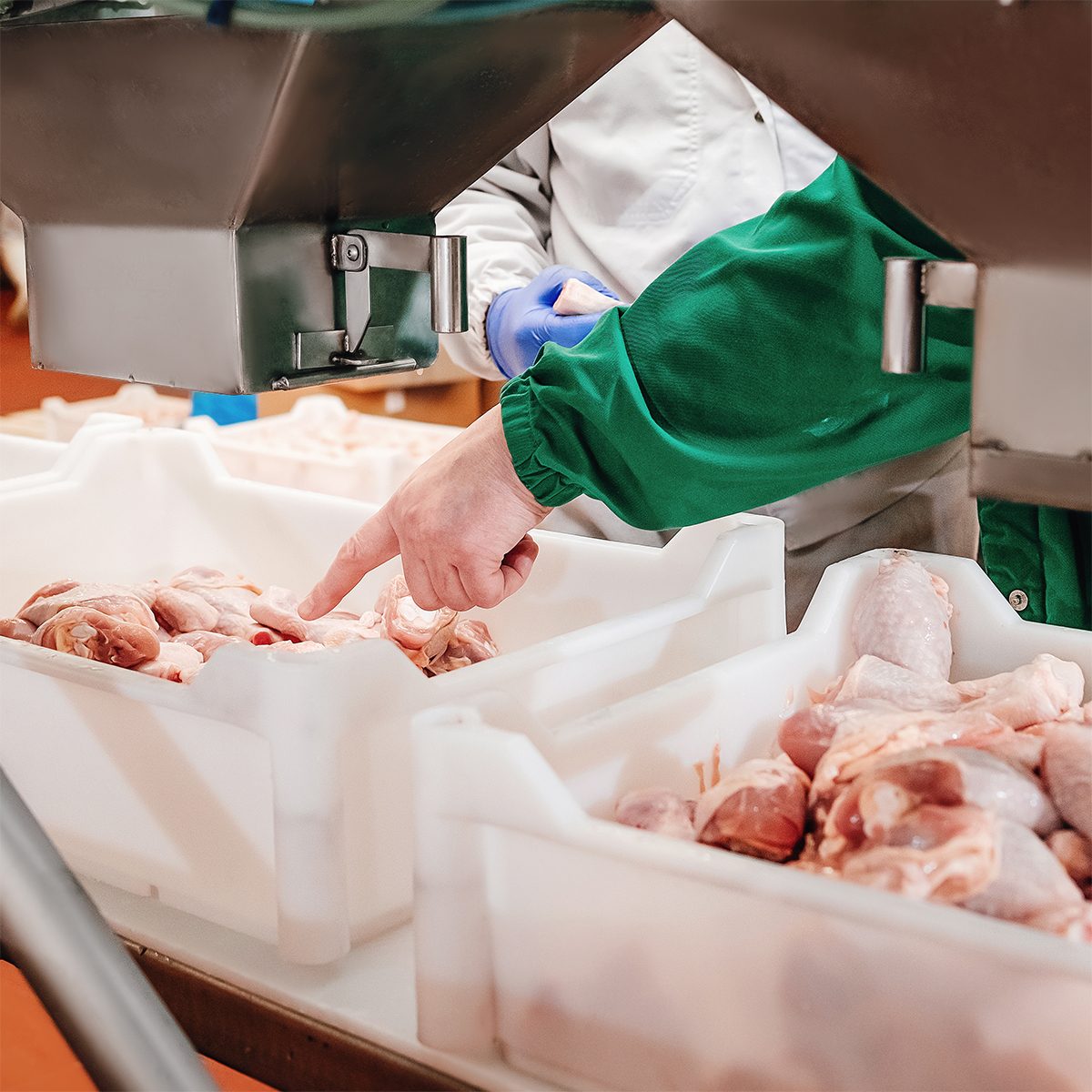
Even when trimming and checking are performed well, value can still escape through how by-products and finished pieces are routed. Robust recapture practices advance meat processing yield gains by converting potential waste into revenue.
Separate and monetize by-products
Feathers, bones, and offal account for a substantial portion of live weight in poultry and carry meaningful value in red meat. Efficient separation and routing recovers revenue while preventing cross-contamination that leads to rework.
Direct each product to the optimal customer specification
When multiple customers maintain different specifications and price points, matching each piece to its best-fit specification maximizes realized value and minimizes downgrades. This is especially important for high-variance items and borderline pieces.
Prevent misallocation at the point of origin
When routing occurs late or manually without measurement, the plant absorbs avoidable downgrades. Introduce an allocation check early in the process, based on measured features rather than visual judgment alone.
Further-processed yield is equally important
For marinated or cooked products, tumbling and massaging techniques that enhance protein extraction and water retention reduce cook loss and boost yield. Apply intermittent cycles and vacuum to strengthen binding and shorten cycle time without compromising texture.
What to track in this section
- By-product recovery percentage by category
- Downgrade and misallocation rates
- Cook loss percentages for further-processed items (before and after parameter adjustments)
Facilities that deploy real-time visibility and guided correction typically recover approximately 1–1.5% in yield gains while strengthening spec conformance and lowering rework.
Automation that connects trim, checking, and recapture for meat processing yield gains
The most effective way to multiply gains is to measure every product in motion and convert that data into immediate, actionable guidance. Automated systems accelerate meat processing yield gains by ensuring best practices remain consistent and continuous.
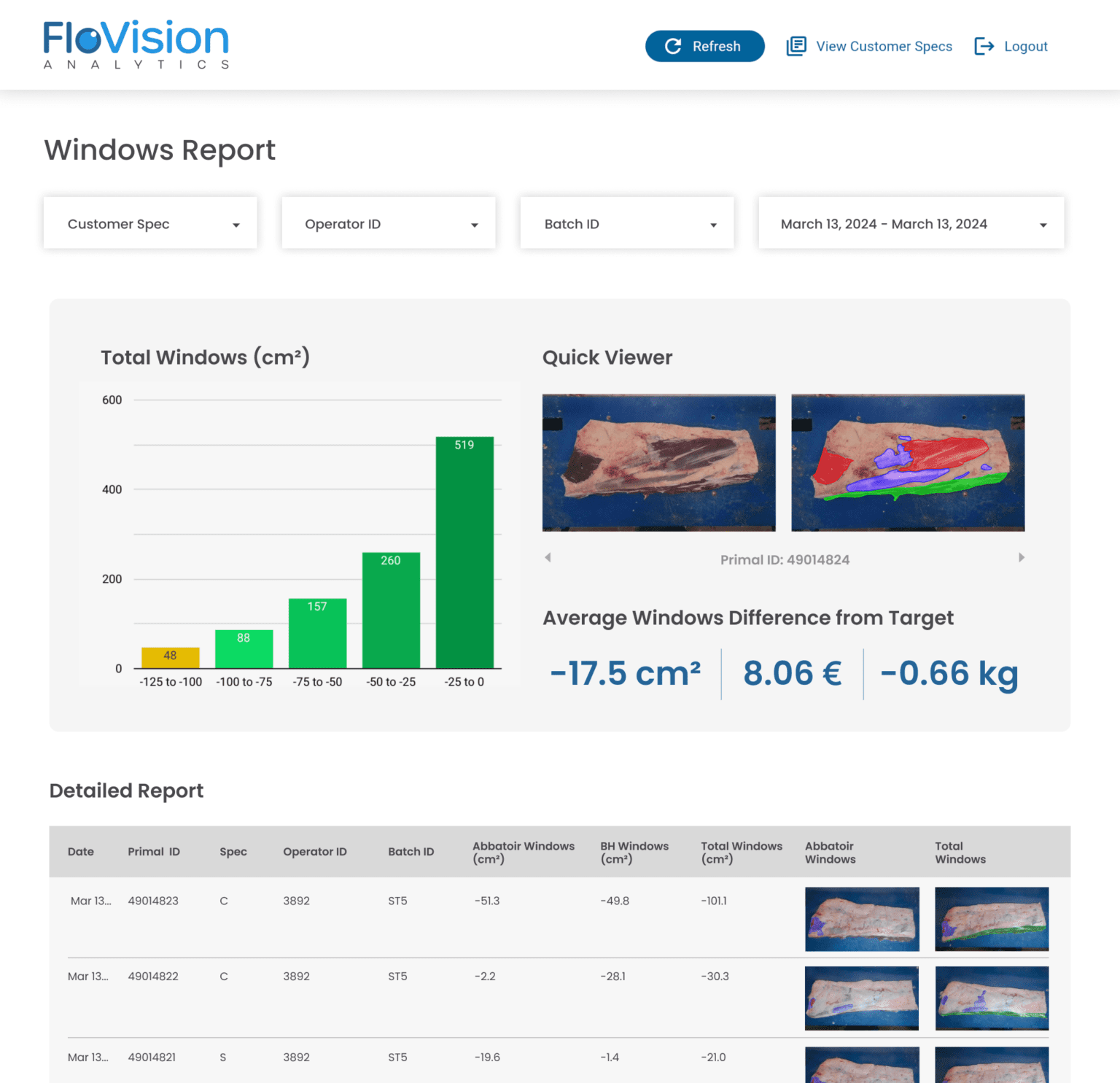
Line-wide visibility and sorting: FloVision Nano
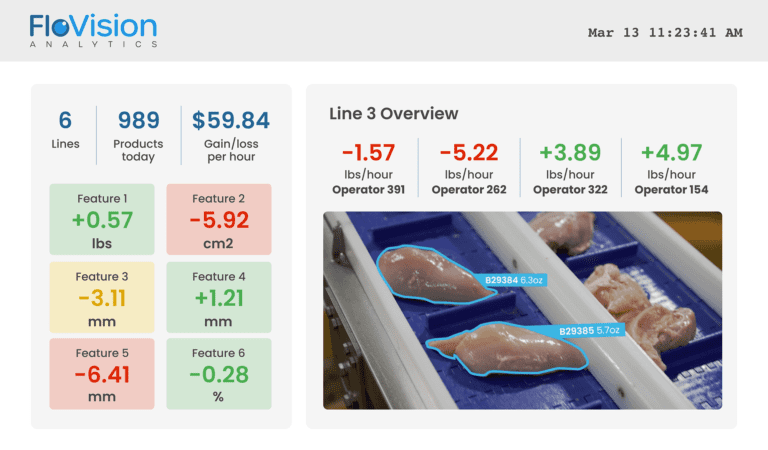
FloVision Nano scans, measures, and monitors each product on a production conveyor. It identifies yield loss, foreign bodies, spec compliance deviations, defects, quality anomalies, and performance concerns, while delivering traceability across the entire production system. It can automatically sort products by grade, customer specification, or product type to position each piece where it generates the greatest value.
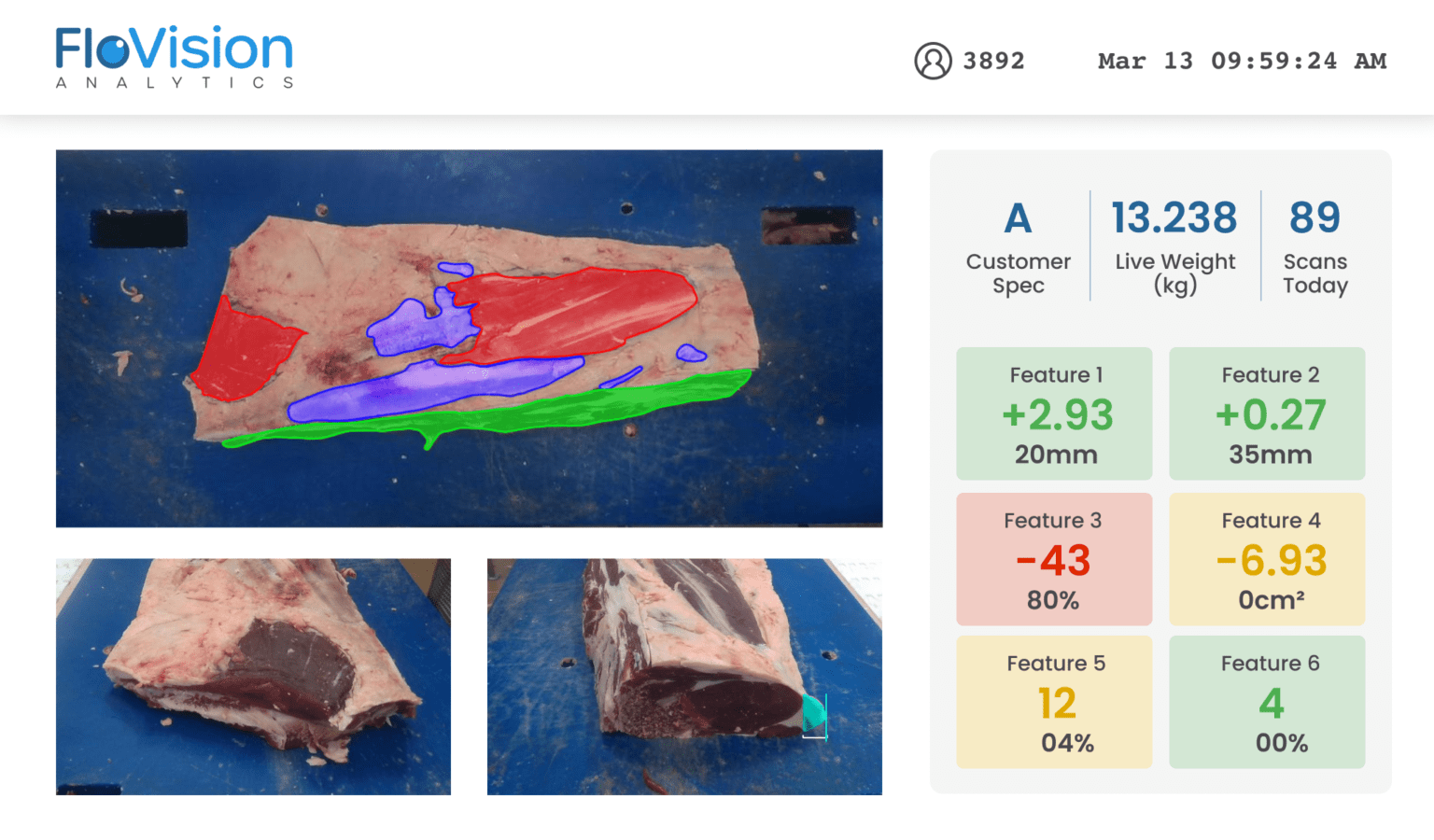
Station-level guidance and feedback: FloVision Pro
FloVision Pro evaluates products at the workstation and delivers real-time feedback on yield loss, spec conformance, defects, operator performance, and product quality. Laser or projection guidance enables operators to execute the precise cuts that match the specification, minimizing over-trim and rework while developing the skills of less experienced cutters.
Automation integrates with your systems to boost yield
- Trim: Operators cut to specification with visual guidance at the point of decision
- Checking: Deviations prompt immediate correction rather than end-of-line rework
- Recapturing: Products are routed and sorted to the highest-value destination automatically
ROI overview
Take a mid-size beef or pork facility as an example. If your annual sellable output is $100M, a 1.0% meat processing yield gain equates to approximately $1M in additional sellable product with comparable inputs. At 1.5%, that figure reaches $1.5M. The same principle applies to poultry at higher throughputs, where minor per-piece improvements accumulate rapidly at line speeds approved up to 175 BPM.
Bringing it all together
The path to a consistent 1.5% meat processing yield gain is not a single solution. It requires a disciplined combination of:
- Well-defined trim standards and targeted operator coaching
- Rigorous in-line checks that reveal problems in minutes rather than hours
- Strategic recapture that monetizes by-products and directs pieces to the appropriate customer
- An automation layer that measures 100% of the line and provides real-time operator guidance
Facilities that invest in automated systems achieve the most lasting gains. Begin with one high-variance SKU and a single conveyor or station pilot. Validate the results, then expand.
FLOVISION NANO
Compact AI sensor to measure yield and quality at production speed.